
The Creatine Journal

Brain & focus · 4 min read

Can creatine help brain fog? Here's what the studies found

By the editorial team Updated 17 sources
A woman with long braids reads a book with a mug in hand at home.
Photo: Alexandra Fuller / Unsplash, edited

Short answer

Maybe, in some situations, but not yet for everyday brain fog. Creatine does reach the brain, and it helped memory in older adults, after a night without sleep, and in vegetarians. In rested, healthy adults it mostly did nothing. The one long study in healthy older women found no effect, and nobody has tested it on brain fog in women 30 to 55.

Key takeaways

  • Menopause brain fog is real, common and usually passes. In a study of 2,362 women, learning stalled late in perimenopause and bounced back after menopause.12
  • The best-tested brain effect is a small memory boost in older adults (66 to 76). In younger people, the big reviews found none.567
  • The clearest results came when the brain was under stress: one night without sleep, or a meat-free diet.111213
  • In women, the research is small and mixed, and Europe's food-safety agency said in 2024 that a brain benefit isn't proven.8101516
In this article
  1. First, what is brain fog?
  2. The good news most headlines skip
  3. Why would creatine help a brain at all?
  4. What happens when you add up all the studies?
  5. Where it did help: no sleep, no meat
  6. The long study in women that found nothing
  7. Menopause and long COVID: small and early
  8. So, should you try creatine for brain fog?
  9. What we don’t know yet

First, what is brain fog?

You walk into the kitchen with total confidence, then stand there holding a spoon with no idea why you came. (In fairness, the kitchen seems designed for this.)

That’s brain fog, and it isn’t a medical diagnosis. The International Menopause Society describes it as a bundle of memory and attention slips: losing words and names, losing your train of thought, getting distracted.1 On average, women’s test scores still stay in the normal range.1
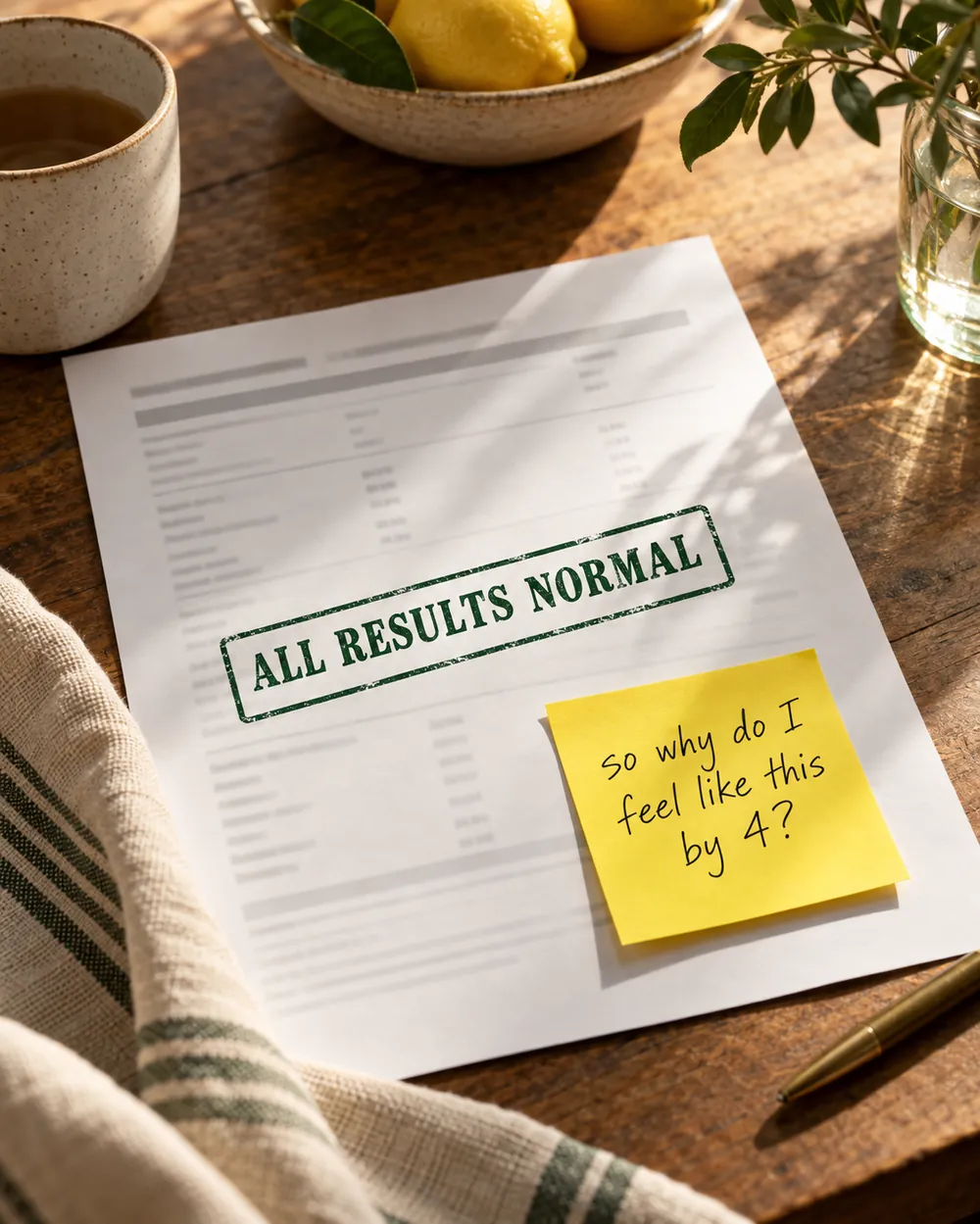
A lab report stamped all results normal with a sticky note asking so why do I feel like this by 4
Normal blood work, foggy afternoons. A very common combination.

The good news most headlines skip

A big US study tested 2,362 midlife women again and again over four years. Usually, people get a little better each time they repeat a test. Late in perimenopause, women stopped getting that boost. After menopause, it came back.2

So for most women, the fog is a phase, not a direction. And dementia in midlife is very rare: about 293 cases per 100,000 women worldwide.1

That makes the real question smaller: can creatine make that phase easier?

Why would creatine help a brain at all?

Your brain keeps a small quick-energy reserve, made from creatine, for busy moments. So researchers wondered: if you top it up, does a brain under pressure work better?

One surprise: in a brain-scan study, women’s brain creatine shifted across the menstrual cycle, while men’s stayed flat.3 You may have read that women simply have less creatine in their brains. The scan studies don’t consistently show that.34

What happens when you add up all the studies?

This is where it gets more interesting than the supplement aisle would like.

In 2018, a review of 6 studies found creatine “may” help short-term memory and reasoning. Young, healthy people showed no change.5

In 2023, a bigger memory review looked like a clear win, especially in adults aged 66 to 76.6 Then two researchers spotted a counting mistake: tests from the same people had been counted as separate results. Once the math was redone, the overall benefit was no longer a real difference. The benefit in older adults held up.7

A 2024 review found faster thinking in women, from just 4 studies,8 but with the same counting problem.9 A hint, not an answer.

Then Europe’s food-safety agency looked at 21 studies to decide whether creatine could be sold as good for thinking. Its 2024 answer was no. A memory effect showed up only at 20 g a day for 5 to 7 days, and a cause-and-effect link “has not been established.”10

21studies Europe's food-safety agency reviewed
20 ga day: where a memory effect showed up
2.2-14 ga day: where it didn't
Creatine seems to help a brain that's running low: older, short on sleep, or meat-free. A rested 40-year-old brain is a harder sell.

A woman looks out a misty window on a gray day.
Some days the fog lifts by itself. Some days it needs a plan.Photo: René Porter / Unsplash

Where it did help: no sleep, no meat

The most famous study kept 15 young adults, 8 of them women, awake for 21 hours. Compared with a dummy powder, one big dose of creatine (about 21 g for a 60 kg, or 132 lb, person) improved their memory by about 10%, and their speed of thinking got faster too. It kicked in after about 3.5 hours and lasted up to 9 hours.11

Impressive, but it was one night in a lab, at a dose nobody takes daily. (Big single doses are also where stomach trouble lives.)

Diet matters too. In 128 young women, five days of creatine improved memory in vegetarians, but not in meat-eaters.12 In another study, 5 g a day for six weeks helped young vegetarians with memory and reasoning.13 And in older adults, one week of high-dose creatine improved most of the memory tasks tested.14

The long study in women that found nothing

If you read only one study here, make it this one. Fifty-six healthy older women, average age 67, took creatine or a dummy powder for 24 weeks. Some also did strength training. Creatine didn’t change a single thinking test.15

What did change? Mood got better in the women who lifted, with or without creatine.15 So the best brain news in that study came from the barbell. (Which, admittedly, is harder to sell in a gummy.)

Menopause and long COVID: small and early

Only one study has tested creatine in women around menopause. Thirty-six women took small doses (under 2 g a day) of a different form of creatine for 8 weeks. The higher dose beat the dummy powder on reaction time, and it raised creatine in the brain.16 About 9 women per group, for 8 weeks: promising, not proof.

In long COVID, where most patients are women, a 4-week study of 67 people found that 6 g a day eased fatigue, but 18 g a day didn’t. More than 4 in 10 people on the high dose felt nauseous.17 And nobody measured thinking.

So, should you try creatine for brain fog?

If your fog comes from short nights, a plant-based diet or getting older, creatine has a few promising studies on its side, mostly at higher doses than the usual 3 to 5 g. If it comes from perimenopause, nobody has properly tested it yet.

The things with better backing for menopause brain fog are less exciting: better sleep, treating hot flashes that disrupt your days (they’re linked to memory problems, even apart from sleep), and looking after your mood.1 That’s worth a chat with your doctor before you buy anything.

What we don’t know yet

  • Everyday brain fog in women 30 to 55: no study has tested creatine on it.
  • The right dose: the clearest effects came from high doses for a few days, or one big dose.1011 Whether 3 to 5 g a day helps the brain is unclear.
  • Perimenopause: one study of 36 women, with a different form of creatine.16
  • Hot flashes, sleep and mood: creatine hasn’t been tested on any of them.

Questions women ask

Can creatine help menopause brain fog?

Nobody has tested it on menopause brain fog itself. The only study in women around menopause gave 36 women a small dose of a different form of creatine for 8 weeks, and their reaction time got faster. Menopause fog mostly affects memory for words and usually eases afterward. Sleep, hot flashes and mood are worth raising with your doctor.

How much creatine do the brain studies use?

Anywhere from about 2 g to 20 g a day, or one big single dose. Europe's food-safety agency only saw a working-memory effect at 20 g a day for 5 to 7 days, not at 2.2 to 14 g a day. The usual 3 to 5 g a day has no proven brain benefit yet.

How long does creatine take to work on the brain?

In the sleepless-night study, one big dose kicked in after about 3.5 hours and lasted up to 9 hours. Other studies that found a benefit ran from 5 days to 6 weeks. In healthy older women, 24 weeks made no difference to any thinking test.

Does creatine help after a bad night's sleep?

In one lab study, 15 young adults were kept awake for 21 hours. One big dose of creatine improved their memory and speed of thinking, and made them a little less tired. Nobody has tested it in women who sleep badly night after night, from menopause or a new baby.

Does it work better if I'm vegetarian?

It seems so. In two studies, vegetarians did better on memory tests after creatine, and in one of them meat-eating women didn't. A big review agrees, which fits the idea that creatine helps most when your stores start low.

Can creatine help long COVID brain fog or fatigue?

In a 4-week study of 67 people, mostly women with an average age of 52, 6 g a day eased fatigue but 18 g a day didn't, and the higher dose caused more nausea. Thinking wasn't tested, so brain fog itself is still an open question.

Sources

  1. Maki PM, Jaff NG. Brain fog in menopause: a health-care professional's guide for decision-making and counseling on cognition. Climacteric. 2022;25(6):570–578. doi.org/10.1080/13697137.2022.2122792
  2. Greendale GA et al. Effects of the menopause transition and hormone use on cognitive performance in midlife women (SWAN). Neurology. 2009;72(21):1850–7. pmc.ncbi.nlm.nih.gov/articles/PMC2690984/
  3. Hjelmervik H et al. Sex- and sex hormone-related variations in energy-metabolic frontal brain asymmetries: a magnetic resonance spectroscopy study. NeuroImage. 2018;172:817–825. pubmed.ncbi.nlm.nih.gov/29391242/
  4. Endres D et al. On the effect of sex on prefrontal and cerebellar neurometabolites in healthy adults: an MRS study. Front Hum Neurosci. 2016;10:367. pmc.ncbi.nlm.nih.gov/articles/PMC4969301/
  5. Avgerinos KI et al. Effects of creatine supplementation on cognitive function of healthy individuals: a systematic review of randomized controlled trials. Exp Gerontol. 2018;108:166–173. pmc.ncbi.nlm.nih.gov/articles/PMC6093191/
  6. Prokopidis K et al. Effects of creatine supplementation on memory in healthy individuals: a systematic review and meta-analysis of randomized controlled trials. Nutr Rev. 2023;81(4):416–427. pmc.ncbi.nlm.nih.gov/articles/PMC9999677/
  7. Eckert I, Pascher E. Letter to the Editor; and Prokopidis K et al. Authors' reply with re-analysis. Nutr Rev. 2023;81(11):1495–1500. doi.org/10.1093/nutrit/nuac111
  8. Xu C et al. The effects of creatine supplementation on cognitive function in adults: a systematic review and meta-analysis. Front Nutr. 2024;11:1424972. pmc.ncbi.nlm.nih.gov/articles/PMC11275561/
  9. Citherlet T. Commentary: The effects of creatine supplementation on cognitive function in adults. Front Nutr. 2026;13:1716285. pmc.ncbi.nlm.nih.gov/articles/PMC13105953/
  10. EFSA NDA Panel. Creatine and improvement in cognitive function: evaluation of a health claim pursuant to article 13(5) of Regulation (EC) No 1924/2006. EFSA J. 2024;22(11):e9100. pmc.ncbi.nlm.nih.gov/articles/PMC11574456/
  11. Gordji-Nejad A et al. Single dose creatine improves cognitive performance and induces changes in cerebral high energy phosphates during sleep deprivation. Sci Rep. 2024;14(1):4937. pmc.ncbi.nlm.nih.gov/articles/PMC10902318/
  12. Benton D, Donohoe R. The influence of creatine supplementation on the cognitive functioning of vegetarians and omnivores. Br J Nutr. 2011;105(7):1100–5. pubmed.ncbi.nlm.nih.gov/21118604/
  13. Rae C et al. Oral creatine monohydrate supplementation improves brain performance: a double-blind, placebo-controlled, cross-over trial. Proc Biol Sci. 2003;270(1529):2147–50. pmc.ncbi.nlm.nih.gov/articles/PMC1691485/
  14. McMorris T et al. Creatine supplementation and cognitive performance in elderly individuals. Aging Neuropsychol Cogn. 2007;14(5):517–28. pubmed.ncbi.nlm.nih.gov/17828627/
  15. Alves CRR et al. Creatine supplementation associated or not with strength training upon emotional and cognitive measures in older women: a randomized double-blind study. PLoS One. 2013;8(10):e76301. pmc.ncbi.nlm.nih.gov/articles/PMC3789718/
  16. Korovljev D et al. Effects of 8-week creatine hydrochloride and creatine ethyl ester supplementation in perimenopausal and menopausal women (CONCRET-MENOPA): a randomized controlled trial. J Am Nutr Assoc. 2025. pubmed.ncbi.nlm.nih.gov/40854087/
  17. Dos Santos et al. Creatine supplementation on fatigue related to post-COVID-19 condition: a randomized controlled trial. Front Nutr. 2026;13:1731306. pmc.ncbi.nlm.nih.gov/articles/PMC13058949/

Read next